A CALL FOR SUSTAINABLE AI
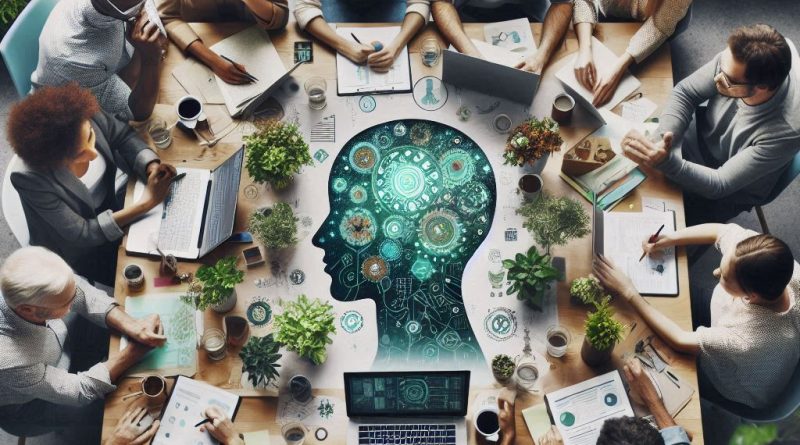
The illustration of this article was created by Gen AI Bing Image Creator, and required 1.35 kWh of energy, which is equivalent to 112 battery charges of a latest generation smartphone model…
The future of AI will be sustainable, transparent and social, or AI will not be…
Today, reading a Linkedin post by my comrade Nicolas Diacono gave me the idea for this article, which can be seen as a response to the issues set out here by Nicolas, i.e. :
“I’m not going to give you the umpteenth analysis of the American announcement on Stargate, but I will share with you a thought and question I’ve been asking myself:
Buying thousands of GPUs is all well and good, but without energy it’s worth absolutely nothing … and in my opinion, the only real lever for independence and technological leadership that we have in France lies in mastering nuclear energy.
So instead of chasing after the American and Chinese giants in AI, wouldn’t it be better to invest massively in inventing the energy of tomorrow? Isn’t energy mastery the real key to dominating tomorrow’s world?
I’d love to hear your thoughts on the subject… ;)” N. Diacono
I think this raises some good questions about the future of artificial intelligence.
My thoughts here:
#1: Concerning nuclear power and France, as mentioned in this post, France to “master” nuclear power needs its fuel, Uranium, and France does not extract Uranium on its territory and is therefore totally dependent on other countries (Over the last 10 years, France has imported 88,200 tons of natural uranium. According to the Euratom Committee, these imports come mainly from 4 countries: Kazakhstan (around 27%), Niger (around 20%), Uzbekistan (around 19%) and Namibia (around 15%). So, 80% of extraction comes from 4 countries. Uranium supply is therefore highly concentrated. A crisis in one of these countries would considerably threaten the nuclear industry. France, and by corollary the EU, has no control over its nuclear industry, which can be described as “fragile” in terms of the reliability of its raw material, uranium.
#2: Yes, the EU has fallen considerably behind the USA and China in the field of AI. And yet… France, for example, has been at the forefront of AI research in this sector since the early days, but this has not been supported at all by the French state. A blatant example of the failed march of digital technology and artificial intelligence over the past 40 years and more: in 1972 (!) the first so-called “logic” programming language, Prolog, was dedicated to developing “intelligent AI-based” machines (the so-called “5th generation” computers at the time, in the early 90s). The French government said no to the researchers at the University of Marseille-Luminy (in European collaboration with the University of Edinburgh in Scotland), who had invented Prolog, in order to release substantial funding to support this major innovation at the time, and it was Japan who came to finance the project on a massive scale, rather than France or the EU at the time. It was at this point that the first AI-powered robots appeared in Japan, long before we saw them in the USA. Examples like this can be told of a plethora of strategic errors in digital investment on the European continent.
Now, the EU is lagging far behind in AI, and yes, I agree with Nicolas, “there’s no point in trying to chase the American and Chinese giants in AI”.
#3: “Wouldn’t it be better to invest massively in inventing tomorrow’s energy?
Indeed, here the finger is pointed at perhaps the biggest structural problem facing AI today: its enormous need for energy and water (to cool its cloud computing servers).
A word of warning here: for those of you who think that “drill, drill, drill” is the way to go, skip it, this article will make you a little angry… and since you’re already angry enough as it is, it’s better for your mental health (I’m not going to make any judgements about your mental health, of course :)) it’s humor isn’t it… or not really :)))
So,
The path taken since 2022 by OpenAI and its ChatGPT and followed worldwide since then has exponentially accentuated AI’s energy requirements. The “brute force” method of training Transformer-type model data explains this. This path towards ever more powerful LLMs is leading to AI entities that are not at all profitable for companies, and which are becoming increasingly unmanageable due to their environmental cost. Big Tech’s announcements that it is buying up old nuclear power plants to meet these huge new energy needs are just… ridiculous, just an announcement effect. After all, it would take at least ten years to get these abandoned nuclear power plants up and running again… 10 years… an eternity for artificial intelligence!
To be more realistic… current AI systems are dominated by LLMs… so we have two choices:
1: resilience
2: to choose and develop another path for AI.
Both choices are possible… As you have understood here, I prefer the second choice…
And for a very simple reason: putting a band-aid on a wound is fine, it makes it stop bleeding… but understanding the cause of the bleeding is always the right lasting solution, whatever happens, otherwise it will always continue to bleed…
So, there are many technical solutions to mitigate the enormous energy needs of LLMs. Here are just a few examples:
Fine tuning/transfer learning, to adjust training to the desired target, to greatly reduce training time,
or
Zero/few shot learning, to train models with much less data, and I’m going on and on about many resilience solutions here.
Then… as for the fight against climate change, either we adapt to it, or we change our model or, given our current (alarming) situation, we do both! Resilience AND building a new sustainable model! Just obvious, isn’t it?
The same applies to AI.
Should we continue with models that will eventually become unmanageable due to their environmental cost (and socila as a result)?
I think not…
And this is where Europe has a “chance” today to take a leadership role in the currently neglected field of “sustainable AI”. As you said Nicolas, the EU and Europe aren’t going to catch up with the USA or China, or India either, when it comes to developing AI in its current form… On the other hand, the EU and the rest of Europe can become a leader in the development of a responsible AI ecosystem, and when I say “responsible”, I mean AI models that are much less energy-intensive, AI models that serve the public good, and finally AI models that are sustainable in the sense that they will benefit both companies and the world citizens. And there is a niche for now for this leadership. It’s also called… Tech For Good…
An example (among many others concerning Tech For Good innovation):
the case of the British company Oriole Networks, which has just received funding of $35 million at the end of 2024 to train language models much more quickly and ecologically. The technique: not using uranium or oil, no… but using light: advanced photonic networks to create and interconnect AI chips! Now that’s responsible innovation! By exploiting the unique properties of light, we can not only considerably speed up data processing, but also drastically reduce energy consumption. Clearly, large language models could be trained up to 100 times faster, while consuming only a fraction of the energy normally required.
This example of innovation and fundamental research can be found in all sectors of AI… Let’s give a strong push for sustainable AI, because current AI, ChatGPT models style, cannot be the future of AI, just another obvious point here.
And one last point, when it comes to quantum computers, Europe is at the cutting edge, Atos for example (or at least what’s left of it, what a waste of one of Europe’s technological flagships!) with Siemens has been at the forefront of Quantum Computing for a long time now, let’s try not to waste this skill once again…
To sum up, the future of AI is sustainable and social, in the sense that it will be designed for the public good and at the same time be turstworthy for its adoption. Those who’ll take this path will undoubtedly have won, and humanity will have won too.
The future of AI will be sustainable, transparent and social, or AI will not be…
Well… for the good of our humanity, I hope at least I am not wrong here…
